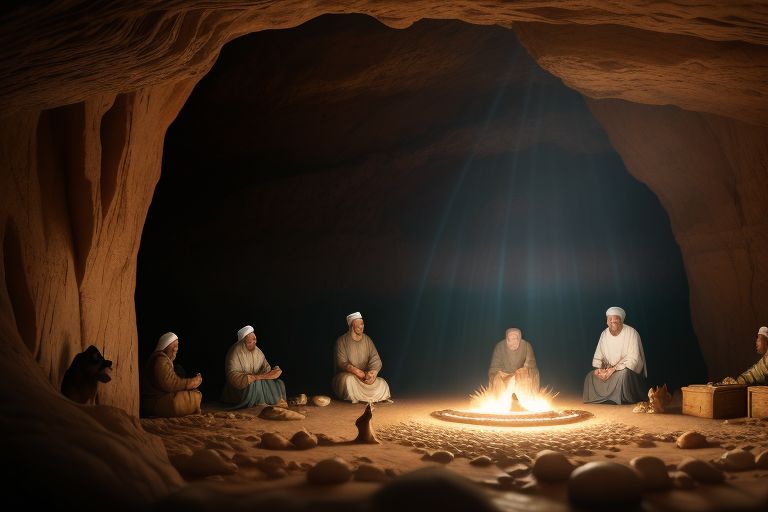

Prayer, Meditation, and Connection with the Creator: A Search for the True Meaning
Introduction: Beyond Rituals, Toward a True Connection
In religious traditions, prayer is often seen as a ritual, a series of actions performed at set times. But was this always the original intent? In the Qur’an, the Hebrew Bible, and ancient texts like the Kolbrin Bible, we find evidence that prayer was initially something much deeper—a spiritual connection, a moment of divine awareness, and an act of inner purification rather than external ritual.
A key example of this is the Qur'anic term Salat (صلاة). Traditionally, it is understood as ritual prayer, but the linguistic root Ṣ-L (صل) carries meanings beyond physical prayer—it implies "connection, turning toward, linking with" something. This opens the possibility that Salat originally referred to a state of spiritual connection rather than just a formalized sequence of movements.
Similarly, the Qur’anic term Junub (جنب), often interpreted as ritual impurity due to sexual relations, may have a broader, more spiritual meaning. The word Junub comes from the root J-N-B (جنب), meaning "to be distant, to be apart." This suggests that being in a state of Junub might not mean physical impurity, but rather spiritual distance from God.
This understanding aligns with the teachings of Yeshua (Jesus) in the Kolbrin Bible and ancient Hebrew scriptures, where purification is not about washing the body but cleansing the soul from inner corruption. As we explore Abraham’s, Isaac’s, and Jacob’s practices of prayer, along with insights from Zohar and mysticism, we begin to see that prayer was never meant to be an empty ritual, but a tool for spiritual transformation.
1. The True Meaning of Salat: A State of Connection
Many religious traditions define prayer in ritualistic terms, but when we analyze the Hebrew Bible and the Qur'an linguistically, a deeper meaning emerges.
A. Salat as "Connection," Not Just Ritual
The root Ṣ-L (صل) implies linking, turning toward, and connecting.
In the Qur’an, Salat is often described as something that prevents immorality and wrongdoing (29:45)—suggesting it is more than a physical act; it is a state of mind and soul.
If Salat is about maintaining a state of divine awareness, then it is much closer to meditation or spiritual alignment than just a ritual.
B. Junub as "Distance," Not Just Physical Impurity
The word Junub (جنب) literally means "to be far from something."
Qur’an 5:6 commands purification before Salat, including full cleansing if one is Junub—but what if this means "cleansing oneself from a state of spiritual distance," not just bodily impurity?
Water, in spiritual texts, often represents knowledge, purification, and divine wisdom. This would mean that the true purification before prayer is about removing distractions and mental barriers that keep us distant from the Divine.
Thus, before connecting with God (Salat), one must cleanse their thoughts, heart, and spirit (removing Junub), rather than just washing the body.
2. Prayer in the Hebrew Bible: A Conversation, Not a Ritual
The Hebrew Bible presents three key figures—Abraham, Isaac, and Jacob—each associated with a particular prayer time. However, a closer look at the original Hebrew terms used in these accounts suggests something much deeper than mere ritual.
A. Abraham’s "Standing" Before God (Genesis 19:27)
The text states that Abraham "stood" (עמד, 'amad) before God. The word 'amad does not simply mean standing in a physical sense but can also mean "presenting oneself before a King" or "being in the presence of authority." This suggests that Abraham's prayer was not a set ritual but an act of placing himself consciously in the presence of the Divine.
B. Isaac’s "Meditation" in the Field (Genesis 24:63)
Isaac is said to have "gone out into the field to meditate" before evening. The Hebrew word Lasuach (לשוח) used here does not mean "to pray" in the structured sense but rather "to converse, reflect, or meditate." This implies that Isaac’s prayer was a form of inward contemplation, a quiet connection with God rather than a recitation of fixed words.
C. Jacob’s "Encounter" With God (Genesis 28:11)
When Jacob stops to rest on his journey, the text states that he "encountered" (ויפגע, va-yifga) the place. The word paga (פגע) has multiple meanings, including "to meet, to reach, to plead," and even "to fall upon." Some interpretations suggest that Jacob did not merely stop at a location but unexpectedly "fell" into an encounter with the Divine—an experience rather than a ritual.
What does this mean?
The Hebrew Bible does not describe these patriarchs performing structured prayers with rigid formulas. Rather, they engage in acts of connection, meditation, contemplation, and surrender to God’s presence.
3. Yeshua’s Teaching on True Cleansing: A Spiritual Transformation
In the Kolbrin Bible, Yeshua offers a profound teaching about the difference between external rituals and internal purification. This aligns perfectly with our study of prayer and spiritual connection.
Yeshua and the Priest Levi (BRT:3:45-47)
"Jesus took the disciples who were with Him into the Court of the Hebrews, which was an inner place, and a warden, a priest named Levi, stopped them, saying to Jesus, ‘Are You an ignorant man? Do You not know it is forbidden to walk here in the presence of holy things without first purifying yourselves? See, those who follow You have not even washed their feet. They enter here defiled by the world.’" (BRT:3:45)
Yeshua’s response is crucial:
"Lord, have mercy on the blind! You have washed in standing water, which may have been befouled by dogs, and scrubbed your outer skin as harlots, singing girls and vain men do who are full of vileness inside. But My disciples and I have little need for outer forms of ritual cleanliness, being clean within, for we have washed in the living waters of the spirit." (BRT:3:46)
This echoes multiple scriptural principles:
1. True purity comes from within, not through external washing.
2. Spiritual cleansing is what matters, not ritual purification.
3. Rituals without inner transformation are meaningless.
🔹 This aligns with the Qur’anic metaphor of water as knowledge and purification, suggesting that the wudu (ablution) could be a spiritual cleansing rather than merely physical.
🔹 It confirms Yeshua’s stance in the Gospels, where He rebukes the Pharisees for being clean on the outside but corrupt within (Matthew 23:25-26).
Thus, just as Junub (being distant from God) requires cleansing, Yeshua teaches that spiritual impurity is removed not by water, but by transforming the heart.
4. The Kolbrin Bible’s View on Rituals and True Worship
The Kolbrin Bible (GLN:15) explicitly criticizes blind ritualism, emphasizing that true devotion to God must be based on sincerity and transformation.
"Prayer serves its true purpose only when it harmonizes your spirit with Mine so communication becomes possible." (GLN:15:7)
"Real and sincere worship is to obey My laws and to shoulder the responsibilities of men… The whole purpose of life is not the service of God, but the development of the soul of man." (GLN:15:12)
These teachings reinforce the idea that true prayer and worship are about inward transformation, not external rituals.
5. The Freedom to Choose: Every Path to God Is Personal
This study does not impose one view of prayer over another. Each person is free to choose how they connect with the Creator. Whether through traditional prayer, silent meditation, personal reflection, or another form of devotion, what matters most is sincerity, transformation, and the elevation of the soul.
Some will find meaning in structured prayer; others will find deeper connection in silence and contemplation.
Some will bow, others will sit in stillness. Some will speak, others will listen.
No path is inherently superior as long as it brings a person closer to God in sincerity.
What truly matters is that one’s connection with the Divine is genuine, heartfelt, and leads to moral and spiritual growth.
"Then you will know the truth, and the truth will set you free." – Yeshua (John 8:32)
May each of us find our own way to the Creator—not out of obligation, but out of love, desire, and a sincere longing for the Source of All.
Final Thought: How Do You Connect With the Divine?
Now that we have explored these ideas, ask yourself:
Is my prayer bringing me closer to God, or has it become routine?
Does my worship transform me spiritually, or is it just a habit?
How can I deepen my connection with the Divine, beyond words and rituals?
The answers lie not in dogma but in your heart.