
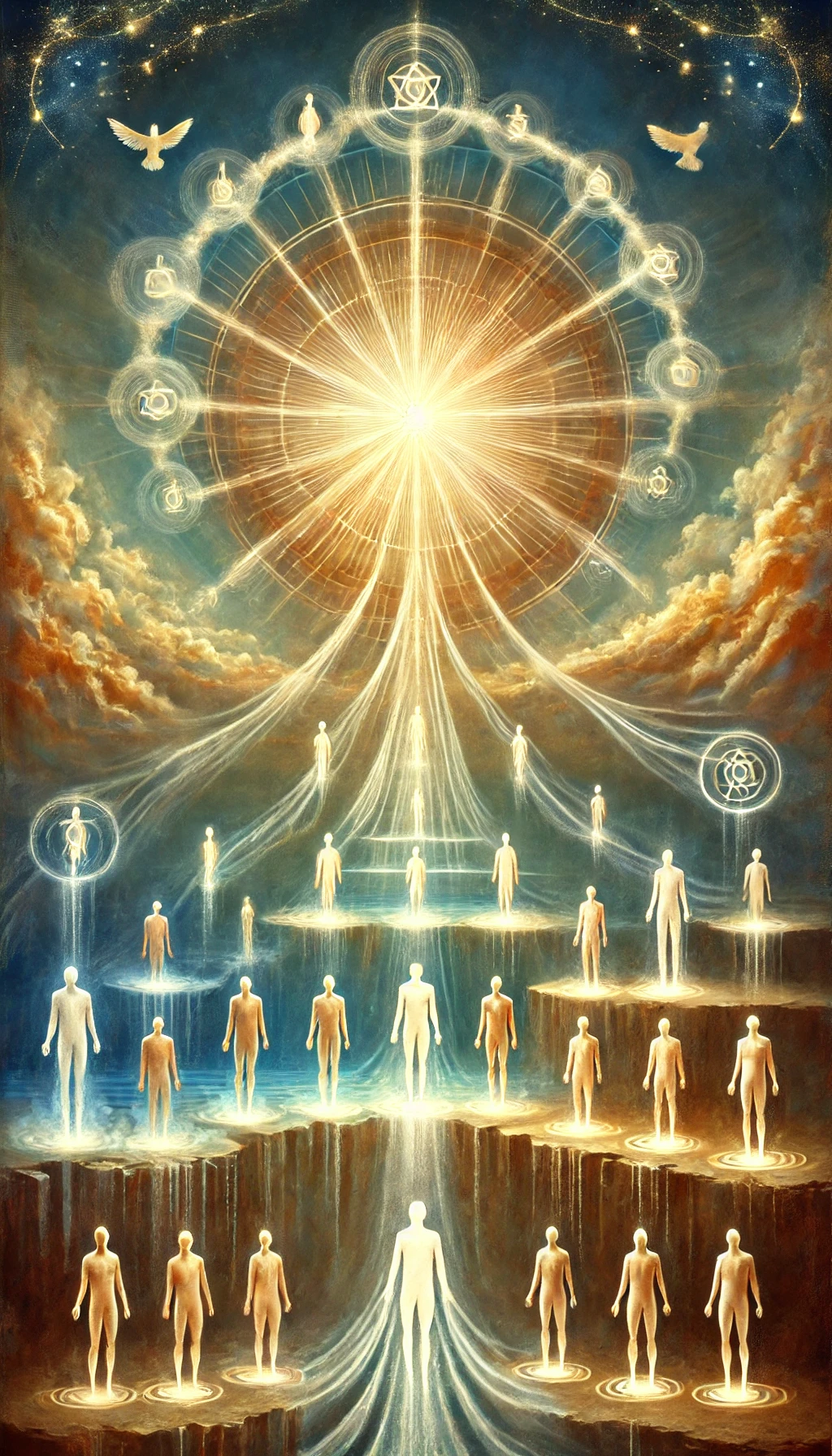
Understanding the "We" in Scripture: Agents of Divine Will
In the exploration of divine texts, one recurring theme is the use of the pronoun "We" when describing actions of the Divine or agents under divine authority. This pronoun, often misunderstood as a “royal plurality,” carries a deeper and more nuanced meaning that sheds light on the relationship between the Creator, the heavenly assembly, and selected human messengers.
This lecture will examine examples from the Qur'an, the Tanakh, and the New Testament to understand how this "We" functions and how certain figures—Moses, Khidr, Muhammad, Yeshua, and the Apostles—demonstrate the dynamics of divine aagency.
1.The "We" as Delegated Authority
The pronoun "We" is used throughout the Qur'an to indicate actions carried out under divine will. However, close examination reveals that it is not always Ellah directly speaking or acting but also includes those empowered by Him.
For example, in Surah Al-Baqarah (2:72-73),
“We said, ‘Strike the [body] with a part of [the cow],’ thus Allah brings the dead to life…”
Here, "We said" refers to divine instructions, yet it is Ellah who is ultimately responsible for the act of reviving the dead.
This distinction suggests a delegation of authority where divine messengers act as intermediaries.
In Surah Al-Kahf (18:65-82), Khidr, a mysterious servant of Ellah, performs seemingly puzzling actions that Moses cannot understand.
Khidr clarifies,
“I did not do it of my own accord” (18:82),
acknowledging that his actions were carried out under divine command. Khidr, as part of the “We,” exemplifies how agents of divine will operate with granted authority yet remain subject to Ellah's ultimate sovereignty.
2. Moses as an Elohim
The Torah itself provides examples of human figures acting as divine agents. In Exodus 7:1, Yahweh tells Moses,
“See, I have made you like God (Elohim) to Pharaoh, and your brother Aaron shall be your prophet.”
This statement places Moses in the role of a divine agent, exercising authority over Pharaoh, but clearly distinguishes him from the Creator.
Similarly, in the Qur'an, Moses is described as receiving divine instructions directly, yet the "We" occasionally appears, emphasizing that Moses operated under divine delegation, surrounded by a divine assembly that supported his mission.
3. The Prophetic "We" in Muhammad
In the Qur'an, the Prophet Muhammad is explicitly mentioned as a representative of Ellah's will:
“Whoever obeys the Messenger has obeyed Allah” (4:80).
This verse reflects a profound concept: obedience to Muhammad is equivalent to obedience to Ellah because he speaks and acts as a divinely appointed messenger.
When the Qur'an uses the phrase
“By your Lord, We shall question them all” (15:92-93),
it highlights how the “We” includes both the divine source and the agents who carry out Allah’s decrees.
Muhammad, as part of this framework, functions as a conduit through which divine authority is manifested.
4. Yeshua and the Oneness with the Father
In the New Testament, Yeshua (Jesus) embodies the concept of divine agency in his teachings and actions. He states,
“Whoever has seen me has seen the Father” (John 14:9)
and
“I and the Father are one” (John 10:30).
These declarations do not imply that Yeshua is the Creator Himself but rather emphasize his role as a direct representative of divine will, mirroring the Father’s attributes and authority.
Yeshua further extends this concept to his followers, stating,
“As you, Father, are in me and I am in you, may they also be in us” (John 17:21).
This unification of purpose and will between the Father, Yeshua, and the Apostles reflects the same dynamic seen in the Qur'anic "We"—a collective carrying out the Creator's will.
5. The "We" in Dialogue with Nicodemus
An intriguing example of the "We" appears in John 3:11, where Yeshua tells Nicodemus:
“Truly, truly, I say to you, We speak of what We know, and bear witness to what We have seen, but you do not receive our testimony.”
Here, Yeshua speaks in the plural, likely including himself and the divine assembly of witnesses. This aligns with the broader understanding of "We" as encompassing both heavenly and earthly agents acting in harmony with divine truth.
6. The Apostles as Extensions of Divine Will
In the New Testament, the Apostles are described as extensions of divine authority, empowered by Yeshua and the Holy Spirit to act on behalf of the Creator.
Yeshua tells them,
“Whoever listens to you listens to me; whoever rejects you rejects me; but whoever rejects me rejects Him who sent me” (Luke 10:16).
This chain of delegation—from the Father to Yeshua, and from Yeshua to the Apostles—illustrates how the "We" operates across different contexts and agents.
Conclusion: The "We" as a Model of Divine Delegation
From the Qur'an to the Tanakh and the New Testament, the pronoun "We" reflects a profound theological principle: the Creator operates through a network of agents—be they angels, prophets, or righteous servants—who carry out His will.
These agents are empowered to act with divine authority but remain distinct from the Creator.
Moses, Khidr, Muhammad, Yeshua, and the Apostles all exemplify this principle, serving as bridges between the divine and the human.
Understanding the "We" in this light allows us to move beyond dogmatic interpretations and appreciate the layered complexity of divine action in sacred texts.
Ultimately, the "We" invites us to reflect on the Creator’s method of engaging with creation through delegated authority, affirming both His transcendence and His immanence in the world.
And for those who abuse this way of carrying out will of Ellah through messengers, whether heavenly, or earthly, spiritual, or material, trying to single out some of them by creating idols for themselves, the Qur'an gives a warning in the following examples:
"The Messiah would never disdain to be a servant of God, nor would the angels who are close to Him. He will gather before Him all those who disdain His worship and are arrogant:" (Qur'an 4:172)
And this
"Those who say, ‘Ellah is the Messiah, the son of Mary,’ are defying the truth. Say, ‘If it had been will of Ellah, could anyone have prevented Him from destroying the Messiah, son of Mary, together with his mother and everyone else on earth? Control of the heavens and earth and all that is between them belongs to Ellah: He creates whatever He will. Ellah has power over everything.’" (Qur'an 5:17)
So it is very important to understand that all exist only because Ellah want, it is all his creation, Ellah is all, but nothing is Ellah.
Ellah choose to act through messengers, earthly and heavenly, spiritual or material, Ellah does not depend on anything, and everyone depends on Him.