
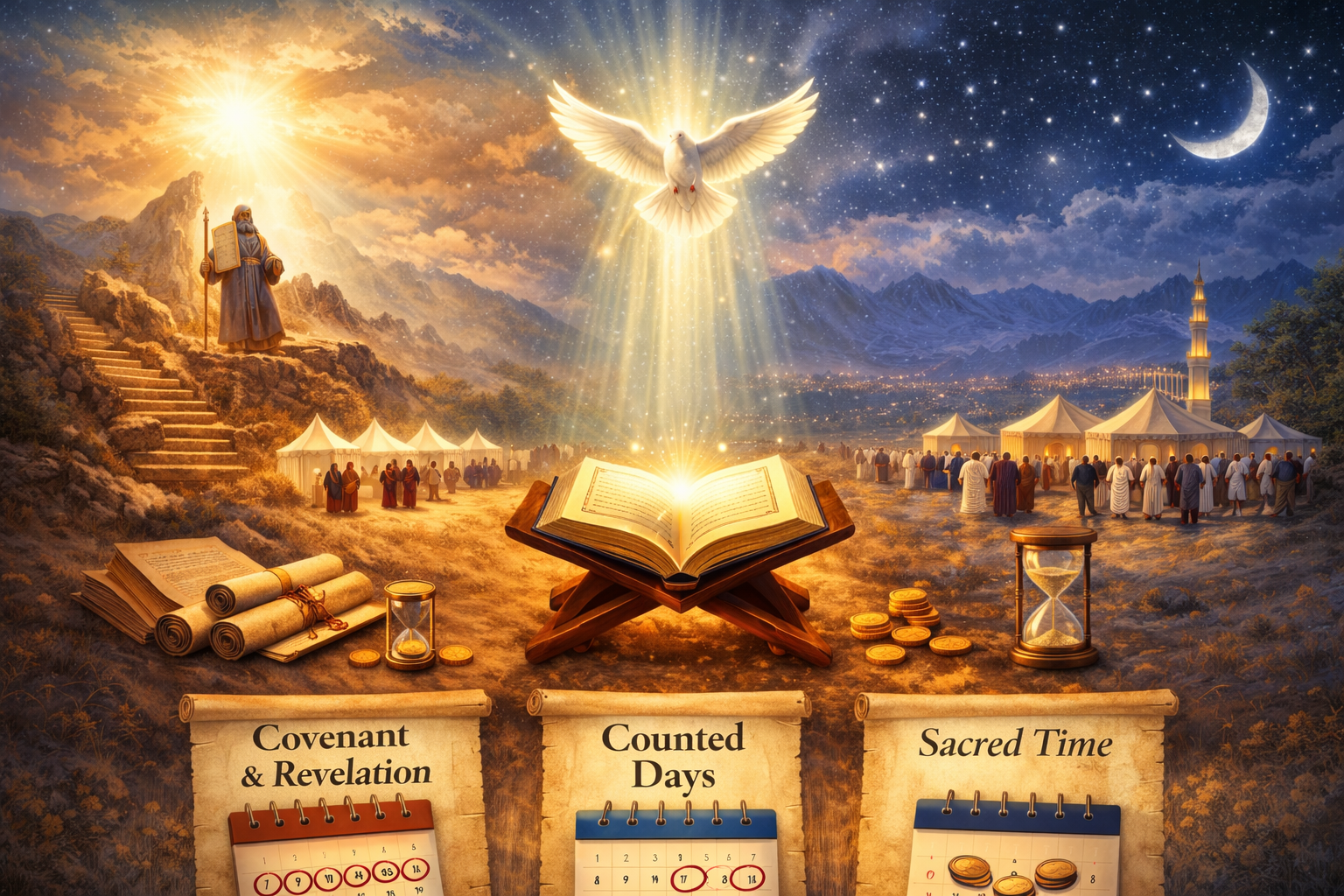
1) Method: The Text Interprets the Text (Not Tradition)
This lesson begins with a simple methodological foundation:
- ✅ The Qur’an interprets the Qur’an
- ✅ Tradition (tafsīr, ḥadīth, practice) can exist, but must not override the text
- ✅ When a “ready-made conclusion” appears (e.g., 30 days), the first question must be:
Does this appear in the Qur’an — or has it been inserted as an assumption?
2) The Key Term: أَيَّامًا مَعْدُودَاتٍ (ayyāman maʿdūdāt)
The Qur’an defines fasting first like this:
أَيَّامًا مَعْدُودَاتٍ
counted / countable days (Qur’an 2:184)
This is a precise expression. Not “precise” in the sense of giving an exact date, but precise in the sense that it:
- limits the burden
- signals that the number is small and countable
- does not speak of “a month,” but of “days”
If the Qur’an wanted to say “fast the entire month,” it could have said:
- شَهْرًا (a month)
- or “fast the month of Ramadan”
- or “fast throughout the whole month”
But the Qur’an does not say that.
3) The Strongest Proof from the Qur’an: The Same Term in Hajj Means 2–3 Days
The Qur’an uses the same expression in the context of Hajj:
وَاذْكُرُوا اللَّهَ فِي أَيَّامٍ مَعْدُودَاتٍ
“Remember Allah in counted days…” (2:203)
And immediately after that, the Qur’an explains what this means:
“Whoever hastens in two days—there is no sin upon him; and whoever delays—there is no sin upon him.”
Therefore:
✅ maʿdūdāt = 2 days (or 3) in the same Qur’anic language.
So it is impossible for the same term in fasting to suddenly mean “29/30 days.”
4) The Qur’an Can Be Mathematically Precise When It Wants To
A common claim is:
“If Allah wanted it precise, He would have said it precisely.”
But the Qur’an is precise when the command requires precision:
- fasting two consecutive months (kaffāra)
- feeding 60 poor people
- clear numerical models
This means:
- ✅ the problem is not the Arabic language
- ✅ the issue is that in 2:184 fasting is intentionally framed as counted days—without turning it into “a month of fasting”
Internal Qur’anic Usage of “Counted / Few”: Yusuf, the Israelites, and Hajj
The term “counted” (مَعْدُودَات / مَعْدُودَة) appears multiple times in the Qur’an and repeatedly carries the sense of a small, limited amount when contrasted with something larger. For example:
- Yusuf (12:20): Joseph is sold for a small / counted price — indicating a low, limited amount of money.
- The Israelites’ illusion (2:80; 3:24): “The Fire will not touch us except for a few / counted days” — explicitly meaning a short period.
- Hajj (2:203): “counted days” are immediately clarified as two days (or staying longer = three).
In all these cases, the meaning points to a small, countable amount, not to an entire month-length cycle.
5) Ramadan Is the Time-Window of Revelation — While the Fast Was Already Defined as “Days”
In 2:185, the Qur’an states that Ramadan is the month in which the Qur’an was sent down, and then says:
فَمَن شَهِدَ مِنكُمُ ٱلشَّهْرَ فَلْيَصُمْهُ
It is commonly translated as:
“Whoever witnesses the month, let him fast the month.”
But the issue is that people insert an extra conclusion:
- “fast the entire month” (which is not explicitly stated)
Because the Qur’an has already defined the fasting in the previous verse:
- ✅ fasting = counted days
- ✅ Ramadan = the month of revelation (a time-frame)
Therefore 2:185 does not “change” the duration of the fast; it places the already-defined fast within the month:
Whoever is present in that month → let him perform the fasting prescribed in that month.
6) Compensation Is in Days, Not a Month
The Qur’an says:
Whoever is ill or traveling → the same number of other days.
If fasting were “the entire month,” one would expect wording like:
- “fast another month”
- “fast the next month”
But the Qur’an speaks in terms of:
- ✅ days as the unit of fasting
- ✅ compensation in days
This undermines the model of “a month of fasting.”
7) A Parallel from the Tanakh: “The Fast of the Fifth Month” Never Means the Entire Month
In Zechariah, we read about:
- the fast of the fifth month
- the fast of the seventh month
- the fast of the tenth month
And no one ever understood that as:
“fast the entire fifth month.”
It is always understood as:
- ✅ specific days within that month (the month is the context)
- ✅ tied to a specific event (the reason/purpose)
The same mechanism appears in the Qur’an:
- the month indicates the context
- the days indicate the duration
ADDENDUM: The Descent of the Spirit, the Feast of Weeks, and “Ramadan as the Month of Covenant”
8) A Member of the FB Group Unconsciously Confirmed the Pattern: The Spirit Descends on the Feast of Weeks
In the discussion, something was unconsciously confirmed:
The Holy Spirit descended on the Feast of Weeks (Pentecost).
This means:
- ✅ the descent of the Spirit is tied to a concrete sacred time
- ✅ it has a cyclical calendar structure
- ✅ it is not a “random metaphor”
The Qur’an says that the Rūḥ descends in Laylat al-Qadr within Ramadan. Regardless of how later dogma tries to fix exact dates, the structural pattern is the same:
- Spirit / revelation
- tied to sacred time
- within a known covenantal cycle
9) Jubilees: The Third Month Is the Month of Covenant, and Revelation Climaxes Around Mid-Month
The Book of Jubilees connects:
- the covenant with Noah
- the covenant with Abraham
- the covenant with Moses
to the same time-frame—the third month (the month of covenant).
In that pattern, revelation does not arrive through a “magical night of the 27th,” but through:
- ✅ a public covenantal event
- ✅ sacred assembly
- ✅ the festival structure (Weeks)
This aligns with the logic:
- fasting as preparation
- counting as the path
- encounter/assembly as the goal
10) What Tradition Did: It “Hit” the Month, but Invented the Mechanism
There exists a hadith that places previous scriptures and revelation into Ramadan by numbered nights (1st, 6th, 13th, 24th, etc.). This suggests:
- ✅ the month was likely “hit” because it preserves an older covenantal framework of revelation
- ❌ but the numerological fragmentation “by nights” looks like a later add-on
In other words: the framework remained, but the content/mechanism was changed.
Hadith Citation (as a Secondary Witness of the Month, Not the Mechanism)
The report often cited in this context is:
Wathila ibn al-Asqa’ reported: The Messenger of Allah, peace and blessings be upon him, said, “The scriptures of Abraham, upon him be peace, were revealed on the first night of Ramadan. The Torah was revealed after six nights of Ramadan had passed, the Gospel was revealed after thirteen nights of Ramadan had passed, and the Quran was revealed after twenty-four nights of Ramadan had passed.”
The point here is not to grant hadith interpretive authority over the Qur’an, but to show a pattern: it “preserves” the month as a memory, while the numbering-by-nights reads like a later rationalization of practice.
Practical Model: How the Text Frames the Fast (6 Points)
- The fast is within the Month of Revelation (Ramadan), in continuity with the covenant/revelation pattern and the descent of the Spirit at the Feast of Weeks.
- The fast is not the month itself, but ayyāman maʿdūdāt (“counted days”), which the Qur’an itself clarifies in 2:203 as 2–3 days.
- Therefore, fasting is not “30 days,” but a few days (a real, limited number, depending on intention).
- Fasting does not extend across sacred convocations (jumuʿah / cessation from work). If jumuʿah is sacred time of gathering and cessation, then fasting cannot override such a day, because it is a day of assembly and encounter, not a day of deprivation. Therefore ayyāman maʿdūdāt logically remains a few days within the week, not a long continuous series.
- The fast functions as preparation rather than burden: fasting → restraint → then festival/thanksgiving and enjoyment of the Lord’s blessings.
- The fast naturally begins at the start of the month, after the new moon, because this marks entry into the sacred period.
Conclusion (One Sentence)
The Qur’an does not introduce “30 days of fasting” as a new law, but confirms an existing pattern of sacred time
- ✅ Ramadan is “probably” the month of revelation “in accordance with the texts of the Qur’an and the previous books regarding the month of revelation”
- ✅ fasting = ayyāman maʿdūdāt (counted days)
- ✅ confirmed by internal Qur’anic parallels (Hajj = 2–3 days, Yusuf sold for a small amount, the Israelites and “a few days” of punishment)
- ✅ confirmed by the covenant/revelation pattern and the descent of the Spirit within the festival cycle
Everything else (the 27th night, 30 days as dogma) comes from later “closing” of what the Qur’an left functional and open.