
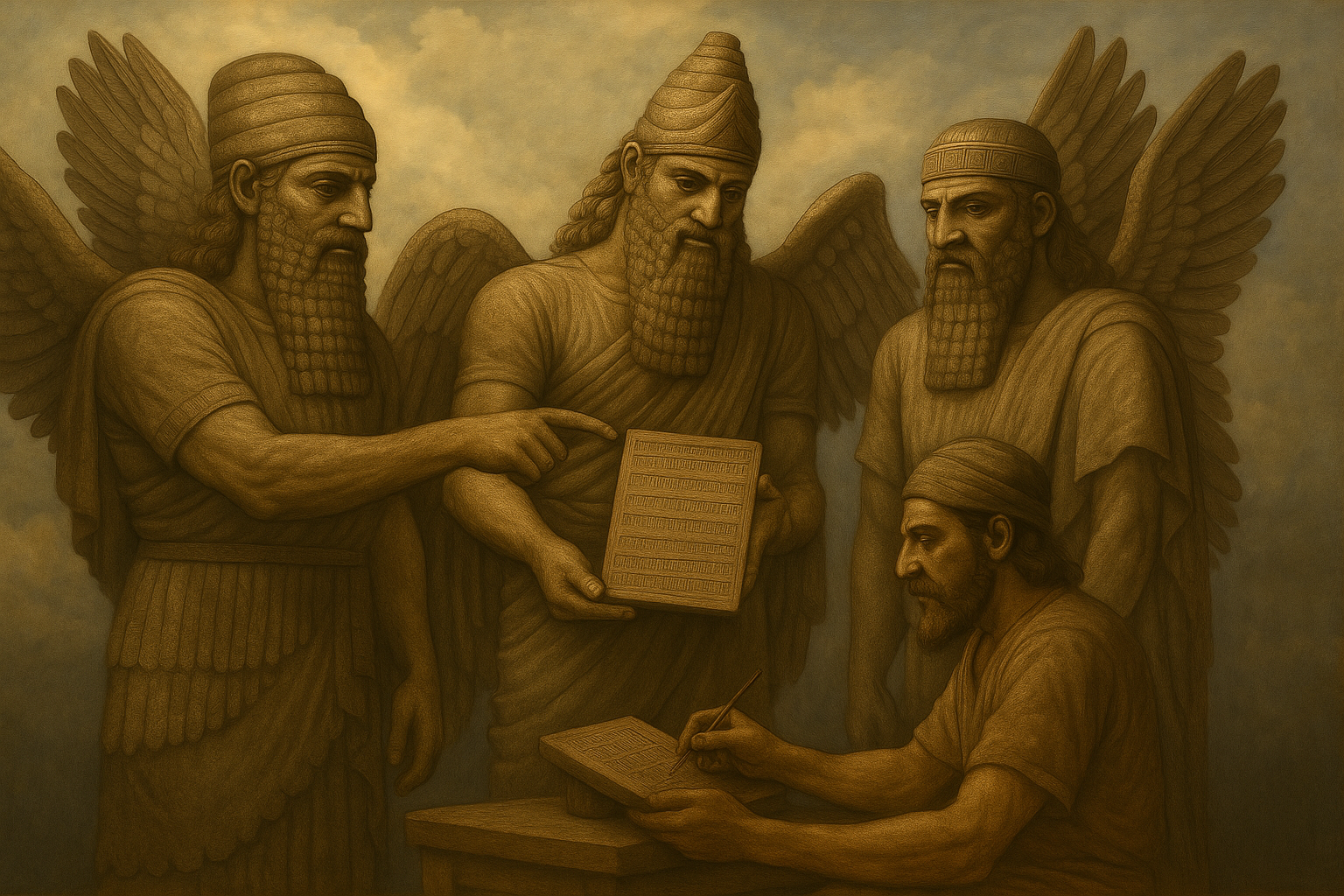
The Question of Angelic Free Will: Revisiting Harut, Marut, and the Watchers
There is broad agreement that angels are intelligent and conscious beings, and that the Qur’an is the criterion (furqan) for measuring truth. Yet certain assumptions—such as the claim that angels are ontologically incapable of disobedience—deserve careful re-examination.
In Qur’an 2:30, angels voice concern over the creation of mankind. This act of questioning shows that angels possess awareness, judgment, and evaluative reasoning. Such traits open the door to moral choice, even if they ultimately remain obedient.
Nowhere does the Qur’an state that angels cannot disobey. In Surah 21:27, it says:
“They do not precede Him in speech, and they act by His command (bi-amrihi ya‘malūn).”
But it does not say “they act only by His command” (lā ya‘malūna illā bi-amrihi). It is a description of loyalty, not a metaphysical limit.
Then 21:28 adds:
“And they, out of fear of Him, are apprehensive (mushfiqūn).”
The word mushfiqūn implies anxious concern. But fear only makes sense if failure is possible. What would they fear if error were impossible?
Surah 2:102 references Harut and Marut:
“They did not teach anyone without saying, ‘We are only a trial, so do not disbelieve.’”
This clearly indicates awareness of consequence and the possibility of misguidance — not blind execution. A warning implies responsibility.
This narrative aligns with the Zohar (section 178–179), which tells how the angels Aza and Azael objected to man’s creation, claiming:
“He will sin through his wife, who is darkness. Why create a being destined to fall?”
But the Shekhinah responded:
“You will fall by the very thing you condemn. Adam will sin with one woman; you will fall with many.”
And as Genesis 6:2 recounts:
“The sons of Elohim saw the daughters of men, that they were beautiful…”
The plural “daughters” confirms the warning. These angels fell not by chance, but through pride. They believed they were incorruptible — and failed.
The Zohar continues:
“For man, repentance was prepared; but for angels, atonement has no effect.”
This mirrors the Qur’an’s recurring theme: status does not remove responsibility. Even Iblis fell, though once honored.
The Book of Jubilees (ch. 4) provides historical context:
- The Watchers descended in the time of Jared,
- They were sent to teach justice,
- But they sinned with the daughters of men,
- And Enoch testified against them.
The Qur’an condenses this, but doesn’t contradict it. The story of Harut and Marut is a partial confirmation of this older tradition. And the trial they underwent was no less real than man’s.
Saying they acted "by permission" does not mean they lacked choice — divine permission enables a test, it does not force its outcome. Moral freedom lies in being given a scenario and choosing how to respond, just as it does for humans.
As for using the Zohar or other ancient texts: I do not believe that truth is found in only one book while all others are false. That mindset is dogmatic and self-defeating. Instead, I treat sacred texts as fragments of a greater puzzle — each with light and distortion.
The Qur’an itself claims to confirm what came before (3:3; 2:41). Stories like Iblis’ fall or Harut and Marut’s descent appear in earlier scriptures, often in fuller form. I compare across traditions because truth is coherent, and it leaves patterns across time.
You may cite 86:13:
“Indeed, it is a decisive word (qawl fasl).”
And I agree. That “decisive word” is not afraid of scrutiny. Truth from God welcomes examination. The Qur’an invites us to reflect and examine.
As it states in 39:18:
“Those who listen to the word and follow the best of it — they are the ones whom Allah has guided, and they are the people of understanding.”
Truth only shines brighter the deeper we seek it.